Against the Tide
Electorates across Latin America are turning to the right, either rejecting left-wing incumbents, as in Chile and Honduras, or cementing the position of incumbent right-wing regimes, as in Argentina, Ecuador and Costa Rica.
However, Colombia just might buck that trend. Left-wing senator Iván Cepeda is comfortably leading in the polls for the upcoming presidential election on May 31st. What explains the resilience of the left in Colombia?
Core voters
Senator Cepeda, hand-picked successor to President Gustavo Petro, has at least a 10-point lead over his closest rivals in most polls. In Colombia’s legislative elections on March 8th, the left-wing party Pacto Histórico (Pacto) cemented its position as the dominant force on the left of politics. Pacto is the largest party in both houses of the legislature, though it lacks a majority (as it has throughout Petro’s term).
A recent CNC poll is fairly typical in showing Cepeda commanding 34.5%, far ahead of the other likely challengers Paloma Valencia (22.2%) and Abelardo De la Espriella (15.4%).
To understand the resilience of the left-wing vote, it is important to note that Colombia was not a part of the so-called “pink tide” of the 2000s that brought left-leaning populist leaders to power. Colombia is remarkably economically unequal by the standards of the region and until 2022 power had traded hands between different factions of the land-owning elite. Thus the Petro administration is their first experiment with left-wing leadership and the Colombian left has not been tainted by the excesses of leftist strongmen as it has in Ecuador and Bolivia, not to mention Venezuela.
Petro’s administration has struggled to make tangible progress. The country’s Gini Coefficient, which measures inequality, has hardly changed during Petro’s presidency. Distribution of land ownership remains remarkably unequal, with 81% of farmers owning just 5% of agricultural land. Health reform has been frustrated in congress. The administration has been distracted by high turnover of ministers and corruption allegations relating to the presidents son and wife.
The change delivered by Petro may have been underwhelming, but he has used his position to continue campaigning. For four years, Colombians have had a president who talks about regional and class inequalities, with the result that many Colombians feel seen by a political party for the first time. Petro’s base is considered to represent around a third of the electorate and his continual, fiery campaigning has been effective at keeping them engaged.
Meanwhile, lacking a broad coalition in congress has stalled many policies, but it has provided the government with a convenient political scapegoat.
Cepeda has spent his long career in politics advocating for the rights of the marginalised and the abused. Thus, while he is a more rigorous and less charismatic communicator that Petro, he is able to unite Petro’s base by showing himself to be a true ideological successor.
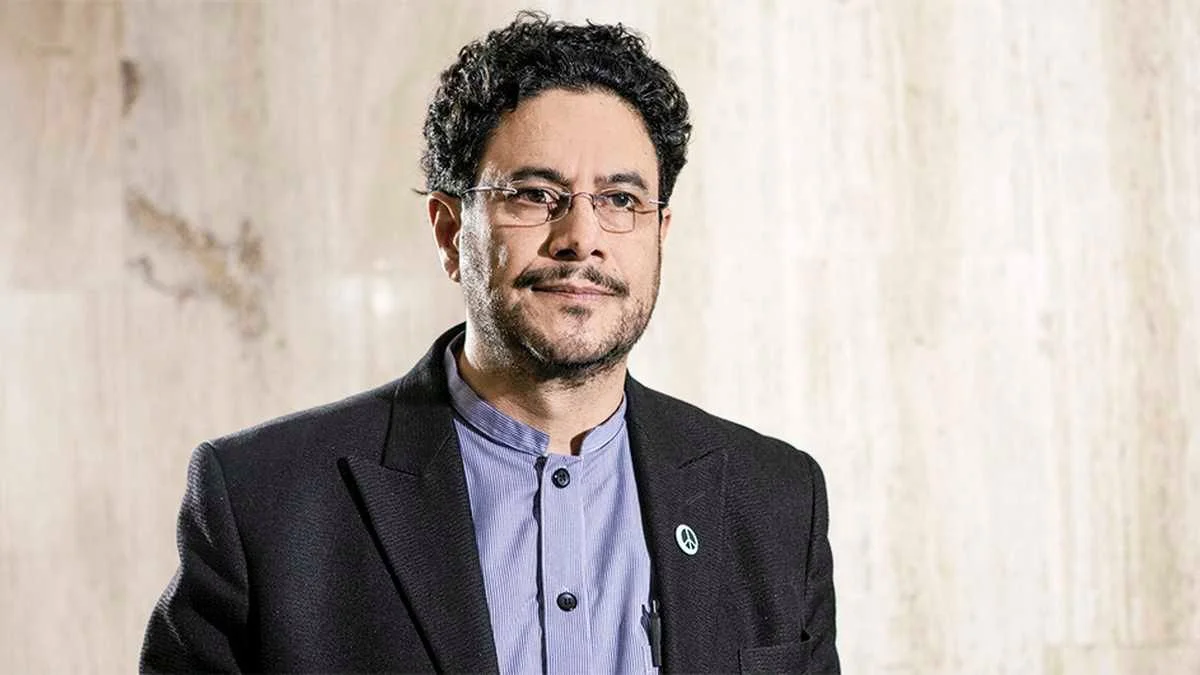
Senator Iván Cepeda is the son a left-wing leader and congressman who was assassinated on August 9, 1994, by state agents
There may be 30% of the electorate who have found a home on the left of Colombian politics, but Cepeda will need broader support to win an election, as Petro managed four years ago.
Minimum wage
While Petro has a strong connection with his core voters, his approval rating has rocketed since the turn of the year. In fact, from February 2025 to February 2026 his approval went from 32% to 49%. There are probably two key reasons for this. The first is that Petro has secured recent wins for the bank balances of key constituents.
First, government authored legislation secured a pay boost for soldiers carrying out mandatory military service. Then, after mouch wrangling, Petro decreed a 23% increase in the minimum wage, a policy which the government claims will benefit 2.5 million people. Whether this has unintended consequences for the job market, as some critics have warned, remains to be seen. Nevertheless, it sends a huge statement to working-class Colombians, that a left-wing government is capable of delivering substantive change in the face of congressional and elite opposition. Valencia and De la Espriella, candidates of the right, have relatively little to say about addressing economic inequality.
Trump effect
The second boon for the left has been Petro’s diplomatic détente with Donald Trump. After months of escalating rhetoric and threats of reduced cooperation, Trump and Petro have made peace, at least for now.
In the aftermath of the US kidnapping of Nicolas Maduro from Caracas in January, Trump and Petro spoke on the phone before a meeting in Washington DC, which both reported was a success. Whether because or in spite of his fierce and often petulant stance towards Trump, Petro has come out strengthened. He pleased his supporters by standing up to US intervention, while managing to avoid losing access to the substantive military aid and diplomatic privileges the country has long enjoyed from the US. This will have been a huge cause for relief for many moderate voters in a country that relies on US military aid and intelligence sharing.
Robust US engagement will likely play a part in the final weeks of the campaign. At the present moment, Trump is more or less distracted with his war of choice in Iran, but there’s every reason to think that he will speak his mind in the coming weeks. Sooner or later, Trump will pick a candidate, and it will not be Cepeda. Expect security cooperation and military aid, amongst other threats, to be used as leverage over the Colombian electorate.
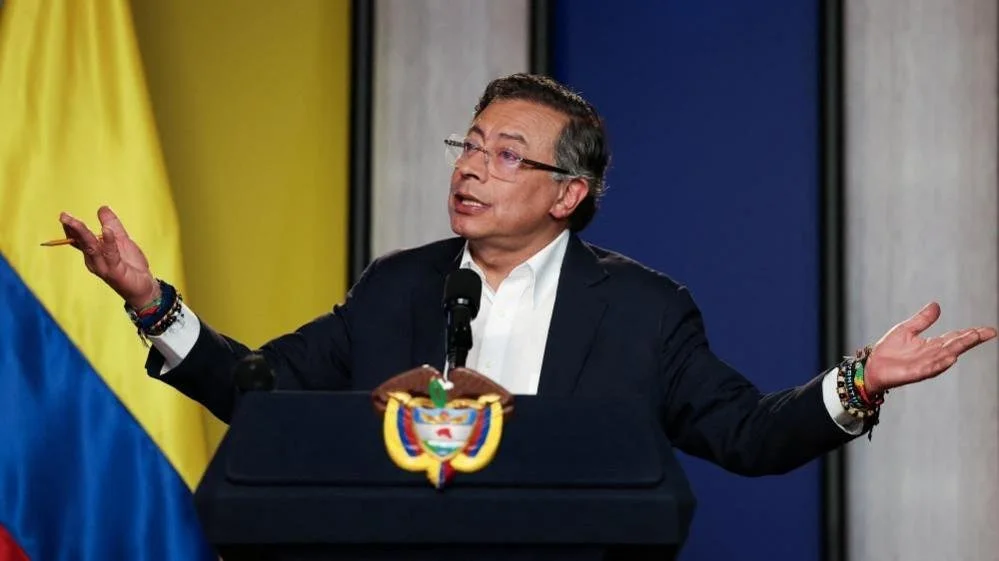
President Gustavo Petro has seen his popularity rebound to almost 50% approval in the final year of his term.
Security concerns
It is possible that Cepeda will benefit from the uptick in Petro’s personal popularity, or indeed Trump’s unpopularity. However, the policy area with which he is associated is not international relations or labour reform, but security. Security is an area in which the administration has a serious vulnerability.
One of the key drivers of the rightward turn in Latin America is the deterioration of public security, whether real or perceived. In Colombia’s case, the deterioration is real. Last year, presidential candidate Miguel Uribe was assassinated at a campaign event.
The UN has reported that cocaine production, one of the key drivers of conflict, is peaking. It is well-documented that armed groups have been gaining ground while FARC dissidents have been incresaing child recruitment. It is no surprise that over 30% of Colombians consider public security to be the main problem facing the country.
Cepeda, who acted as a negotiator in the peace talks with the FARC from 2014-2016, has been closely connected with Petro’s flagship security policy Paz Total (Total Peace), which sought to simultaneously negotiate with various armed groups, including FARC dissidents. Total Peace has failed to bring about resolutions to the numerous armed conflicts besetting rural Colombia. According to International Crisis Group, armed groups came to the table in bad faith and used the reprieve of ceasefires to expand their areas of control. The administration recalibrated in the last year and have put significant military pressure on the guerrillas, but the human cost of the regime’s tactical naivety has been high.
Cepeda promises to double down on negotiations if elected. The right will be working hard to ensure the security debate dominates the last weeks of the campaign.
Polarization
Another problem for Cepeda is that his polling lead is somewhat misleading.
One reason for Cepeda’s apparent dominance of the race at this point is that the left is united behind his candidacy, while the right is split. Polling shows a polarized electorate with few undecided voters and perhaps only 10% favouring centrist candidates.
Even if Cepeda hoovers up these votes and some undecideds by broadening his appeal in the final weeks, he may struggle to achieve 50% in the first round. This will result in a run-off between the top two candidates on June 21st where, from the current viewpoint, Cepeda looks least likely to achieve a majority.
The consolidated right-wing vote would likely surpass his own support in the run-off election while the centrists are more likely to track right, helping either Valencia or De la Espriella to a majority. A similar situation occurred in 2018, when the centrist candidate Sergio Fajardo placed third and his supporters largely backed Iván Duque in the run-off, allowing him to comfortably defeat one Gustavo Petro.
The destination of the Colombian presidency is anyone’s guess at this point, but the Colombian left are not going away any time soon.