Who are the ‘Never Ones’?
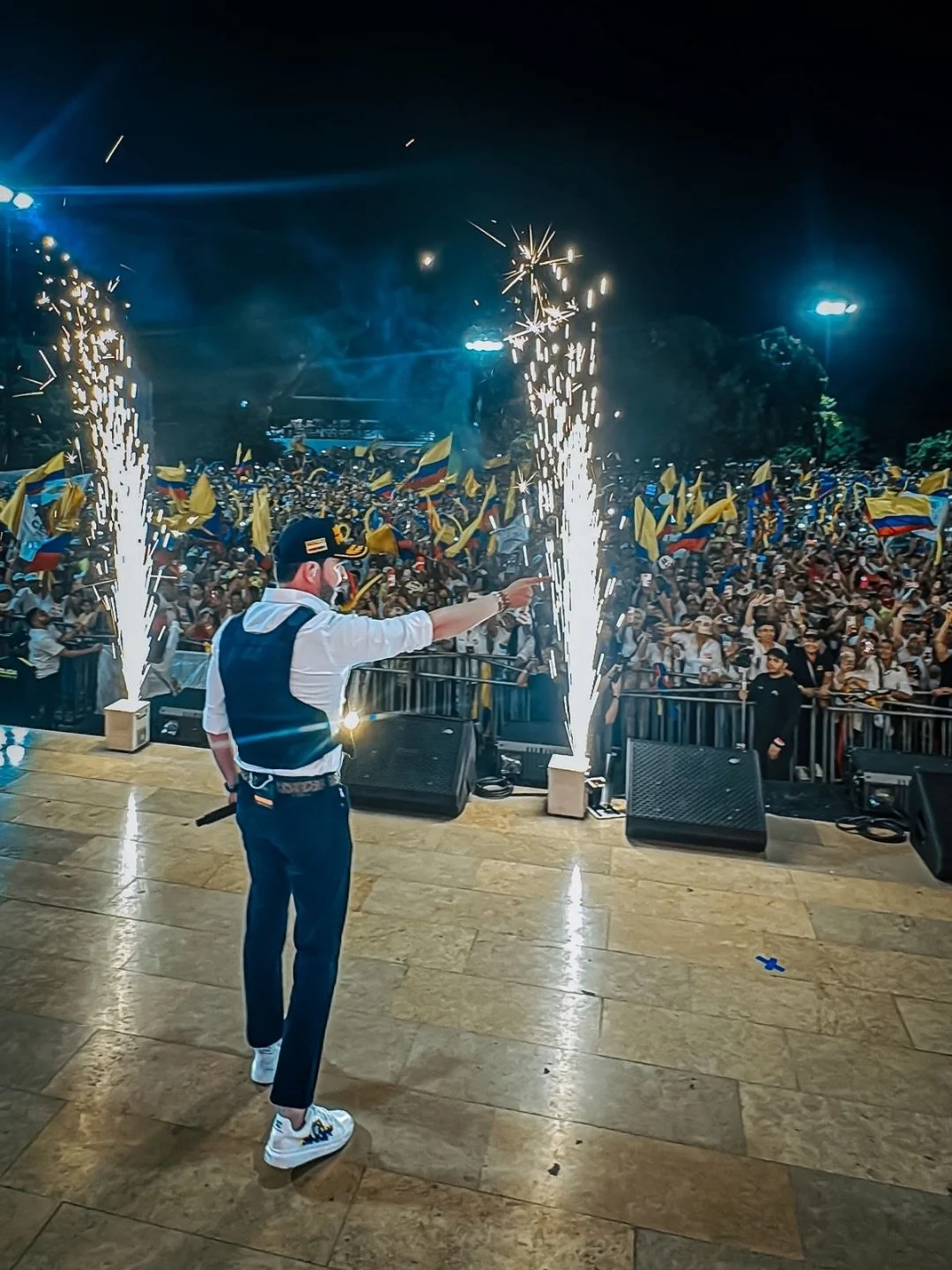
Abelardo de la Espriella at a campaign rally, May 2026.
On the taxi ride into town from Bogotá’s El Dorado airport a billboard looms in the sky high above the freeway. A man with neatly trimmed facial hair salutes the traffic beside the words “somos los nunca” (we are the never ones).
The man is Abelardo de la Espriella and there’s a good chance he might be the next president of Colombia.
A charismatic and slippery figure who has described himself as “right-wing, pure and hard,” de la Espriella has developed a loyal following based on fairly minimal policy offering, by presenting himself as an outsider who can save Colombia from “los de siempre” (the always ones).
Who are the nunca? My first assumption when I began to see the los de nunca vs. los de siempre narrative was that de la Espriella was trying to position himself as on the side of the labouring classes, who spend their days in the fields, forests, mines and markets of Colombia, and who are not given sufficient consideration by the famously closed elites of Bogotá and Medellín.
This appeared to be a repeat of the move pulled by left-wing populist Gustavo Petro, who won the presidency in 2022 promising to give a voice to “los nadies” (the nobodies). The difference, of course, being that Petro has spent his career campaigning for the rights of poor and marginalised Colombians.
De la Espriella did not seem to have the CV to make the claim sound authentic. He’s a celebrity lawyer and entrepreneur who is proud of the fact that he has made money and likes to spend it conspicuously. Furthermore, he is building a political platform with the support of some of Colombia’s wealthiest families. Was he trying to pull the wool over people’s eyes?
It wasn’t until I went to one of his political rallies that I realised how different the idea of los nunca was from los nadies. (Read my report for The Bogotá Post here.)
The idea of los nunca is a grievance based on the idea that while much of Colombian society has benefitted from state handouts, either in the form of welfare or through networks of patronage, there is a silent majority who have always been self-sufficient.
In this way, the idea of los siempre is able to mark out both the elite who nominally governed Colombia from independence until 2022, and the leftist regime that swept to power four years ago.
De la Espriella has defined los nunca as, “those of us who have never stolen one peso from the public purse; those of us who have never stopped working; those of us who have never asked for anything for free; those of us who have never lived off the state; those of us who have never lied to the people.”
The statement demonstrates a classic right-wing populist worldview, containing both an argument about the purpose of the state (not there to be lived off) and an enemy of the people (those lie and steal from you).
Los nunca are the hard-working, authentic and self-made Colombians that make up de la Espriella’s constituency.
Who are the other nuncas he has been rubbing shoulders with on his rise from rural Cordoba to being a frontrunner for the presidency?
Legal career
Abelardo, as he is often known, started his business, De la Espriella Lawyers Enterprise, in Barranquilla in 2007.
The firm went on to represent some of Colombia’s most notoriously corrupt business-people and politicians.
De la Espriella has defended his work, saying that every person has the right to a legal defence, but it seems some of his relationships with clients were more than purely professional. One of his clients, Álex Saab, was reportedly the guest of honour at de la Espriella’s 40th birthday celebration in 2018.
Saab, a Colombian businessman, began his career selling keyrings in Barranquilla and made a fortune as a contractor for the Chávez and Maduro regimes in Venezuela, since at least 2011.
His businesses were used to funnel hundreds of millions of dollars of Venezuelan public money into offshore accounts, while building materials and food for poor Venezuelans went undelivered.
De la Espriella began working for Saab at a time when his complicity in the corruption of the Venezuelan regime was already an open secret.
At the time, de la Espriella was not concerned by Saab’s connections to the Chavista regime. In 2018, when Saab fled the country to evade Colombian law enforcement, de la Espriella insisted that, “Mr. Álex Saab has been unjustly trampled, as a result of a despicable strategy implemented by common extortionists.”
Saab later served as Venezuela’s Minister of Industries and National Production. After Maduro’s kidnapping in January this year, he was extradited to the United States and just last week charged with money laundering by a court in Miami.
De la Espriella argues he was deceived by Saab, as he was by another client, David Murcia Guzmán, author of a pyramid scheme that defrauded 190,000 Colombian citizens.
Murcia Guzmán and Saab are undeniably self-made men, but it seems their fortunes were attained by lying and stealing.
The crimes of de la Espriella’s clients, from whom he made a lot of money, complicates his attempt to position himself as the representative of Colombians untouched by corruption, but allow for a certain amount of plausible deniability.

De la Espriella hails from the department of Cordoba on Colombia’s Caribbean coast.
Business interests
De la Espriella acted in a legal capacity for people who were subsequently revealed to be involved in corruption and other crimes, but he also gone into business with people who were previously exposed as corrupt.
Having done well in law, de la Espriella began developing a wider business interests, including a move into rum, real estate, fashion and finance.
In 2013, he purchased land that falls within a coal-mining concession in Cordoba from the family of convicted drug-trafficker Hugues Rodríguez Fuentes, aka “Commander Barbie.” The family are also investors in de la Espriella’s rum brand, Defensor.
Another investor in Defensor is Black Swan Finance Corp., a company owned by Venezuelan-Italian oilman Serafino Iácono. Iácono, whom de la Espriella describes as a “dear friend,” has recently been in the news for selling a luxury apartment to the CEO of Colombian state oil company Ecopetrol at a discount of over USD$200,000.
One of his close partners in business and philanthropy is ex-Governor of Bolivar department, Juan Carlos Gossaín, who was impeached and banned from holding office for ten years for his involvement in the “Hemophilia Cartel.” Under Gossaín’s watch, USD$6 million was improperly paid by the Governor’s office for medicine and care for hemophiliac patients that should have cost a fraction of that amount.
The corruption of de la Espriella’s associates quite often relates to misappropriation of public funds, furthering confounding the idea that los nunca don’t live off the state.
Political career
It is in the observation of de la Espriella’s political background that we see the identity of his true constituency.
Even though he has never previously run for office, de la Espriella is far from a political outsider.
His father was an elected representative of the Cordoba Assembly and ran unsuccessfully to be governor. Abelardo Snr is also reported to be a personal friend of Álvaro Uribe, the former president who still wields huge clout in Colombian politics (and who isn’t backing de la Espriella in the first round).
De la Espriella has said that he began planning his campaign for the presidency when he was “a broke eighteen year-old.”
He turned 18 in 1996, a turbulent year in the history of Cordoba. Paramilitary groups, which had begun consolidating and expanding the use of terror in northern Colombia, forcibly took control of the University of Cordoba. Abelardo de la Espriella, likely a student in Bogotá at the time, must have been watching events back home closely.
Note:
Paramilitarism in Colombia emerged in the 1960s as a counterinsurgency strategy supported by the state to fight leftist guerrillas. By the 1980s, it transformed into a network of private armies funded by wealthy landowners, drug cartels, and state actors.
The paramilitaries pioneered the use of massacres in Colombia as a means of terrorizing local populations and acquiring vast tracts of land. They were responsible for the greatest number of civilian casualties during the conflict, murdering union leaders, peasants, the homeless, and Indigenous people, as well as targeting militants or sympathizers of political parties of the left.
Although the paramilitaries partially demobilized in the 2000s, paramilitary groups remain active in Colombia today. The Clan del Golfo, one of the country’s most powerful drug-trafficking organisations, grew from the ashes of the paramilitary group United Self-Defence Forces of Colombia (AUC).
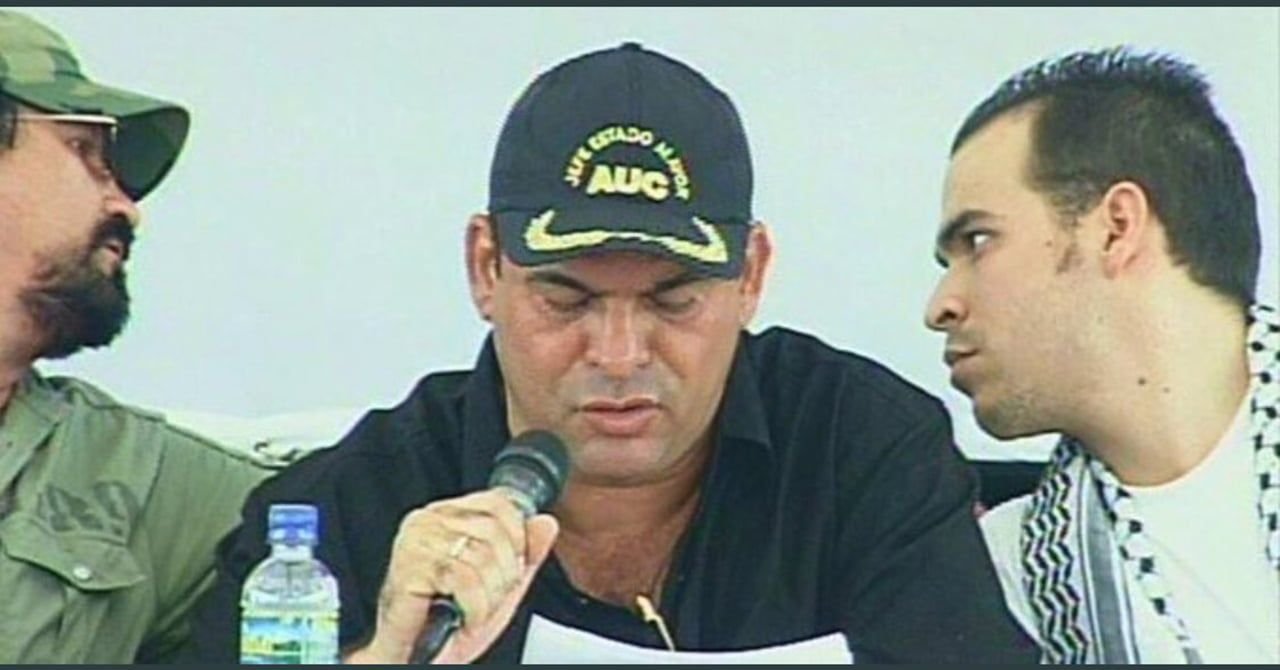
De la Espriella’s first movement in politics came in 2005 with the establishment of Fipaz (Peace Initiatives Foundation) an NGO which declared its mission as to investigate initiatives for peace, but which has been described as “the legal arm of the paramilitary strategy.”
Fipaz representatives also organised events in universities to promote the idea of a referendum on the extradition of paramilitary leaders.
De la Espriella denies that Fipaz existed to advance the cause of paramilitaries, saying, “Fipaz does not participate in proselytizing activities, as its sole objective is to work hand in hand with academia.”
A report from the Coffee Region Fact Check initiative in the newspaper La Patria, found that De la Espriella’s denial of the role of Fipaz in promoting the paramilitary agenda in universities amounts to a half-truth that “corresponds to the available data and facts, but […] leaves out the context necessary to understand the matter.”
It remains an unanswered question how though the foundation appeared in the paramilitaries’ accounting records.
While De la Espriella is careful about the particular aims of Fipaz, he has not been shy about the fact that he admires the paramilitary movement. He has defended paramilitaries as people who were abandoned by the state and so had to look after themselves, even going so far as to say that he would have joined the paramilitaries himself had he been threatened.
Furthermore, he has apparently maintained active friendships with the perpetrators of some of the conflict’s worst atrocities. Salvatore Mancuso, the paramilitary commander whose Catatumbo Bloc murdered over 5,000 civilians, has described de la Espriella as a close friend from childhood and reported that he visited him in jail in the United States after his extradition and conviction.
Who are los nunca?
It might be a bit of a stretch to say that the discourse of los nunca is part of a plot to bring back paramilitarism, if indeed it ever went away.
However, the idea does imply a gloss on the recent history of Colombia in which the threat of the left and the incompetence of the elite gave ordinary people no choice but to stick up for themselves, a narrative that serves paramilitaries and their defenders.
Meanwhile, de la Espriella’s dense web of connections to the underworld raises the possibility of state capture by criminal enterprise were he to win the presidential run-off on June 21st.
The young de la Espriella (R) alongside paramilitary leader and mass-murderer Salvatore Mancuso (C).