Notebook News - Colombia Special
Fighting for the Amazon
Colombia made a bold announcement at COP30 in Belém, Brazil: the entire Colombian Amazon is to become a mining-free zone. By designating the region a Renewable Natural Resources Reserve, the government pledged to prohibit all mineral and fossil-fuel extraction across more than 40 percent of the country, an area containing 10 percent of the planet’s known plant species.
The announcement was framed as both a domestic shift and a call to neighbouring Amazonian countries. Environment Minister Irene Vélez Torres said, “Protecting the Amazon is not an economic sacrifice; it is an ethical investment in the future of the region and of humanity. The rainforest is one, rivers have no borders, and neither does life.” But some of the practical difficulties of such a plan immediately became apparent.
The Amazon is a densely inhabited and contested region, and Colombia’s Ministry of the Interior quickly warned that the proposed reserve would directly affect 566 ethnic communities, many of whom rely on small-scale extraction and forest resources for their livelihoods. Under Colombian law and ILO Convention 169, these communities must be consulted. Whether the government can secure broad support remains uncertain, and the tension between ministries exposed deeper questions about how a blanket prohibition would function in areas already tied to extractive economies. Communities are divided and negotiating with powerful institutions from a position of weakness.
Mocoa, Putomayo is a microcosm of many of these issues.
Copper Giant Resources Corp (CGRC), a Canadian company, plans a vast open-pit copper and molybdenum mine, that it says contains more than a billion tonnes of near-surface copper. The site is just ten kilometres from Mocoa, the regional capital of the amazonian region in south-west Colombia. Mocoa (~60,000 inhabitants) is situated where the Andes descend into the Amazon basin, and is still marked by the 2017 landslide that killed 257 people and swept away five neighbourhoods after heavy rains.
Copper is an essential mineral for the expansion of wind and solar energy, as well as the electrification of transport, and can be recycled endlessly. Mining it also produces unimaginable quantities of waste, much of it poisonous to life. In a typical modern copper mine, where ore grades are 1% or lower, around 400 tonnes of earth must be displaced to produce a single tonne of copper. The process also carries a high risk of heavy-metal contamination of soils and waterways.
For residents who lived through the 2017 landslide, there is an additional fear. Mine waste, or tailings, are often hihgly toxic and require massive containment dams. Under heavy rainfall, these can fail. In the Brazilian Amazon in 2019, the Brumadinho iron ore tailings dam collapsed. 270 people were killed and hundreds of mile of river poisoned. Far from being a one-off, there are an average of two tailings dam collapses per year. Many in Mocoa worry that a tailings collapse could trigger another major landslide, with even deadlier consequences.
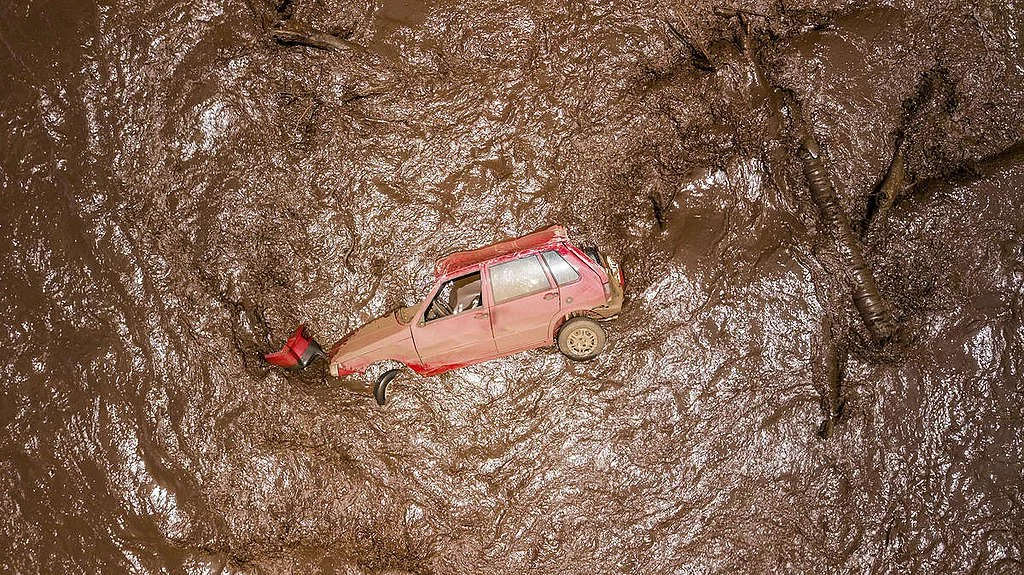
The Brumadinho disaster killed over 270 people
Despite these risks, not all locals are opposed to the mine. CGRC currently employs around 120 local residents. In a town that has absorbed large numbers of families displaced by rural violence, these jobs matter. The result is a divided community, with neighbours and even relatives taking opposing positions.
Constanza, an environmental defender from Mocoa and member of Guardianes de la Andinoamazonia, tells me that the consultation process for the development of the mine is already compromised. She says the company has paid communities, financed football tournaments, and provided gifts to Indigenous leaders, and she reckons now about 20% of the community are in favour. The project is still awaiting licensing, but Constanza already sees the damage the mine is causing. She tells me that the company cut down 150 trees without permission and were punished: “paying fines is just part of the cost of doing business to them. They don’t care about our environment.” She also reported that one river near the current exploration site has already ceased to show any signs of life, which she attributes to early-stage disturbance.
She welcomed the government’s Amazon announcement and says she trusts Minister Vélez Torres, though she remains cautious about whether the broader state will follow through. Still, she is determined. “I really believe we will find a way to stop this mine,” she told me.
Mocoa’s fractures, and the scale of the mining interests involved, highlight a larger truth: declarations at climate summits are easy to make. Implementing them in the politically fractured and environmentally fragile territories of the Amazon is far more difficult.

The proposed open-pit mine is just ten miles from a town of Mocoa in the Colombian Amazon
Collateral Damage
The deaths of seven minors in Colombian strike on FARC dissidents illustrates shortcomings of Gustavo Petro’s Total Peace policy, which has coincided with a rise in the exploitation of children by illegal armed groups. With eight months left of his presidency, Petro has changed tack, with child recruits now accepted as likely collateral damage.
On November 10th, the Colombian military launched a bombing raid to kill the dissident FARC leader who goes by the name of Iván Mordisco. Iván Mordisco survived, but seven children were killed in the bombing, bringing the total of minors killed by Colombian military strikes this year to twelve.

Iván Mordisco, real name Néstor Gregorio Vera Fernández, is a guerrilla leader accused of recruiting hundreds of children into his insurgency
President Petro apologised for the deaths, saying that the minors were not the intended targets, but asserting that, whether children or not, those killed were combatants. The fault lies with the FARC dissidents recruiting and exploiting them. The Attorney General’s Office stood with the president, decrying the recruitment of children by the FARC dissidents and calling it “a practice that constitutes one of the most serious violations of human rights and International Humanitarian Law.”
The failed mission to take out Mordisco represents an apparent change in the administration’s strategy regarding both the FARC dissidents and child protection.
The demobilisation of the majority of the FARC after 2016 led to a power vacuum in many regions of Colombia which, rather than being filled by the state, has been filled with a shifting constellation of armed groups, including FARC dissidents, the leftist ELN, paramilitaries and a new generation of narco-gangs.
Competition between these groups drives the need for fresh recruitment.
The current regime came to power in 2022 with a bold policy called Total Peace, intending to negotiate for the demobilisation of all armed group simultaneously so as to avoid such competition over territory, illicit economies and human resources.
Elections are due in 2026, and with the administration entering its final chapter, progress towards peace has been disappointing. Violence has been increasing as armed groups realise that escalations can strengthen their hand at the negotiation table.
It is in this context that the military have once again begun taking the fight to armed groups such as the FARC dissidents known as Estado Mayor Central, headed by alias Iván Mordisco.
It is difficult to establish how many children are recruited by armed groups each year. Families may not feel able to report cases for fear of reprisals. There are also differing degrees of recruitment: children may continue to live at home whilst being exploited by armed groups as informants, lookouts or drug mules. Their families in some cases may not know that they are being exploited.
Nevertheless, statistics suggest that recruitment has been on the rise since 2020.
The Report on Children in armed conflict from the UN Secretary-General (June 2025) states that 450 children were recruited by armed groups in 2024. Eighty-seven of those children were used in combat roles. Meanwhile, figures released by the Attorney General of Colombia’s office, put the number at 604 children recruited in 2024. This is up from fewer than 300 children recruited per year in the period 2016 to 2020.
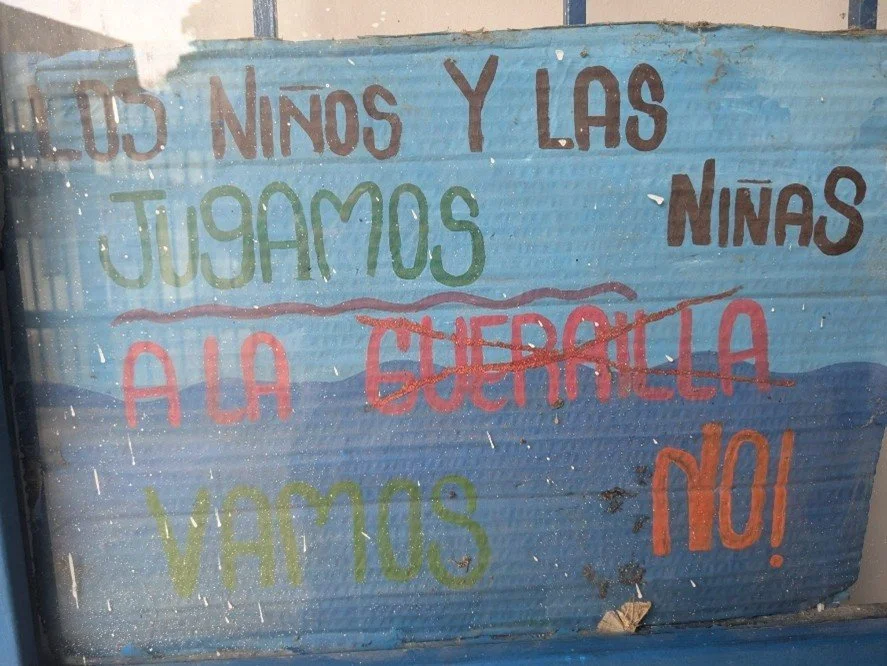
A poster in a youth centre window in Guayabal, Tolima, reads, “Boys and girls, let’s play, not join the guerrillas!”
The average age for recruitment is 14 years and two-thirds of recruits are boys. Whilst some are kidnapped or threatened into service, it has been reported that armed groups in Colombia are increasingly using social media to aid the recruitment. TikTok content showing access to luxury lifestyles as a guerrilla or paramilitary gang member in Colombia have tens of thousands of views.
Children who have escaped, have reported being drawn in because of poverty or the appeal of power, but then finding out that any attempt to leave would be punished by death. Iván Mordisco’s Estado Mayor Central is the armed group seemingly responsible for the majority of child recruitment in recent years, and has been accused of using children as a human shield.
In June 2025, President Petro appointed a new defence minister signalling a change in his approach to peace negotiations. Pedro Sanchez Suarez is the first former military officer in the ministry for 34 years. Later that month it was announced that the military sought to train 16,000 new recruits.
After taking office in August 2022, Petro ordered the indefinite suspension of strikes on illegal armed groups where children were believed to be present.
Petro seems to now admit that this pronouncement was a miscalculation, saying, "If the bombings are suspended, the drug lords will recruit more children, because they will realize that this way they will be protected from greater military risks."
Since Noveber 10th, Petro has insisted that he would continue to pursue the FARC dissidents, regardless of whether children are present.
The attempt on a FARC dissident leader who was recently engaged in peace negotiations with the government, signals that Petro has realised the shortcomings of an approach to illegal armed groups that was all carrot and no stick.
The Social Conditions for Peace
"Art does not change the world. But it does change the people who change the world" – François Matarasso
While much of the policy discussion regarding security in Colombia focuses on military deployments, seizure of illicit goods, and incentives for farmers to stope growing coca, the arts and art education have a key role to play in helping make society more peaceful.
Engaging with art can help people come to terms with brutal histories and imagine different futures. When that art has been created democratically from within communities, it is all the more powerful. Meanwhile, arts education can equip people with ideas, skills, and confidence, fostering a sense of community and the potential for social change.
Colombia’s National Centre for Arts Delia Zapata Olivella, known simply as Delia, is founded on the principle that peace is "essentially a cultural task" and that "culture rebuilds the social fabric." Nicola Torres, who promotes the circulation of performing arts for Delia, tells me that art gives meaning and form to the suffering of communities: “sometimes we dance so that we don’t cry; the body gives form to our pain.”
I went to Tolima, to find out more about Calina Cumbay, one of the projects supported by Delia. Click here to read my report for Latin America Bureau.

Children and adults dancing in Guayabal, Tolima