Notebook News - October 2025
War and Peace in Venezuela
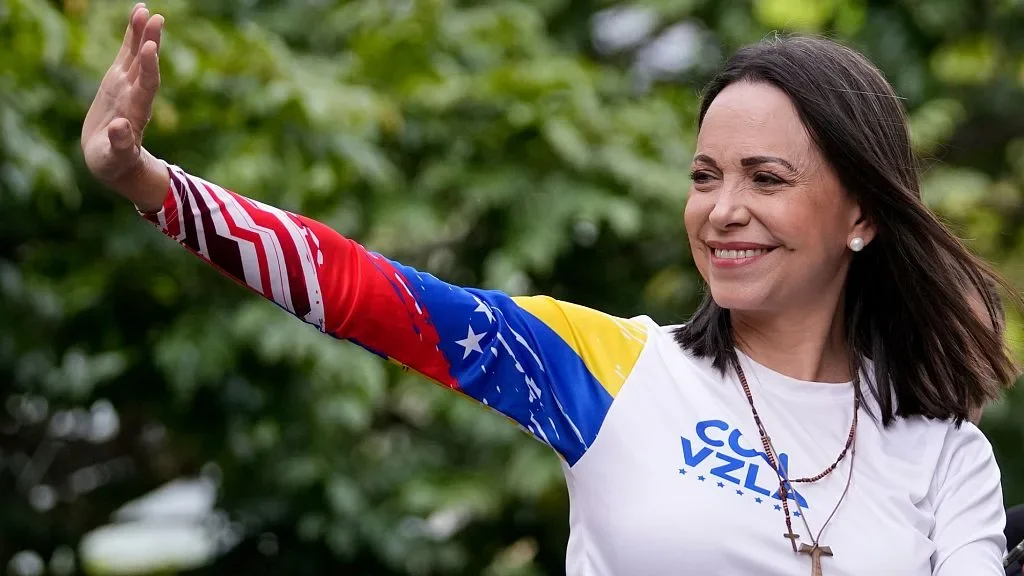
On October 10, it was announced that, for the second time, the Nobel Peace Prize has been awarded to a woman from Latin America. María Corina Machado was commended by the Norwegian committee for her “tireless work promoting democratic rights for the people of Venezuela and for her struggle to achieve a just and peaceful transition from dictatorship to democracy.” Yet Machado’s decision to dedicate the award to President Trump, at the very moment his administration is massing troops and arms in the Caribbean, appears carefully calculated to hasten her rise to power, whether peaceful or otherwise.
Machado has been a central figure in Venezuelan politics since the early 2000s, when she campaigned against constitutional changes extending presidential term limits. Since the death in 2013 of Hugo Chávez and the subsequent collapse of Venezuela’s economy under his successor Nicolás Maduro, she has become the undisputed leader of the opposition. Despite threats to her life, Machado has remained in the country, reportedly hiding in Caracas and narrowly escaping a government abduction after appearing at a rally in January 2024.
Her ability to unify an opposition long divided and demoralized is remarkable. When she was barred from standing in the 2024 presidential election, she threw her weight behind an alternative candidate, Edmundo González, and built a network of independent observers to challenge the regime’s results. When Maduro once again declared himself the winner, González fled. Machado, however, stayed put: defiant and visible.
In that sense, her career makes her a worthy laureate. Yet, her claim that Donald Trump “deserves a Nobel Peace Prize” and her public calls for greater U.S. involvement in ousting Maduro cast doubt on her commitment to a peaceful transition. Since early September, the U.S. military has been blowing up boats it claims, without evidence, are involved in drug trafficking in the Caribbean. At the same time, American forces have been steadily building up their presence in the region, a move that has raised fears of a direct military strike on Venezuelan soil.

Machado has notably refrained from discouraging Washington’s escalating threats. On the contrary, she appears to welcome them, perhaps hoping that the specter of U.S. intervention might persuade Venezuela’s armed forces to abandon Maduro before actual conflict begins. Whether this is political realism or dangerous brinkmanship remains open to question.
The United States has long taken an active interest in Venezuela, home to the world’s second-largest proven oil reserves after Saudi Arabia. During Trump’s first presidency, Washington recognized opposition congressman Juan Guaidó as the country’s legitimate president in a failed attempt to topple Maduro. The current Trump administration appears more determined, and more willing to use military pressure to achieve the same end.
It may be that Trump is preparing for war in Venezuela. It may also be that Machado sees advantage in letting the threat of war hang in the air. In the volatile context of U.S. military operations in the Caribbean, her rhetoric blurs the line between peace and coercion. Such an embrace of American power, explicit or tacit, suggests that Venezuela’s “peaceful transition” may, in fact, depend on the threat of force.

A River Speaks
Illegal gold mining in Colombia’s Chocó Department has turned the Atrato River into a powerful symbol of both ecological collapse and historical continuity. Nearly a decade after Colombia’s Constitutional Court granted the river legal personhood in 2016, a landmark decision meant to guarantee its protection, mining operations have only intensified. The United Nations now describes the situation as a “serious human rights crisis,” citing poisoned waterways, forced labour, people trafficking, and flooding caused by rampant deforestation and erosion.
Stretching 750 kilometres through one of Colombia’s most biodiverse regions, the Atrato is deeply tied to the country’s colonial past. Spanish conquistadors first arrived here in search of gold, decimating Indigenous populations through disease and enslavement before importing thousands of Africans to work the riverbeds. Today, Chocó’s population, roughly 80 percent Afro-descended, alongside Indigenous and mestizo communities, remains shaped by that legacy of extraction and displacement.
It is this long continuum of exploitation that Colombian artist Juan Covelli explores in his latest project, ATRATO, on display at the Victoria and Albert Museum in London until February 22, 2026. The exhibition situates the river’s current devastation within broader patterns of colonization, arguing that the forces that once looted Indigenous tombs now operate through global markets and digital technologies.
Gold, the river’s curse for five centuries, remains central to the story. Its price has almost tripled since 2015, reaching around $3,500 per ounce in 2025. Those profits sustain an illicit economy dominated by organized crime, in which dredging vessels worth hundreds of thousands of dollars are routinely confiscated and quickly replaced. The gold extracted under brutal conditions in Chocó often ends up laundered through international supply chains, indistinguishable from legally mined metal, and ultimately used in electronics and jewellery around the world.
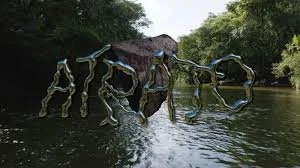
Covelli, who has a BA in Political Science, casts this as a form of digital colonization, a new phase in an old system. He argues that supposedly “clean” technologies conceal centuries of extraction and domination, connecting the digital realm to the environmental and human devastation unfolding in places like Chocó.
The human cost is severe. Mercury, used by miners to separate gold from ore, contaminates the water and accumulates through the food chain. Locals who rely on the river for fish often have dangerously high levels of mercury in their blood, leading to neurological and cardiovascular illnesses. What was once a source of life has become toxic.
Covelli’s installation ultimately present the Atrato as both subject and witness, a river that has seen centuries of violence disguised as progress. By translating environmental destruction into digital form, the work underscores how the global appetite for technology and profit continues to shape the lives of those living along its banks. The story of the Atrato is not just about a river in crisis, but about the enduring cost of a world still driven by extraction.
Projectiles and Poisoned Preserves
President of Ecuador Daniel Noboa claims to have survived not one but two attempts on his life in October. Meanwhile, a thirty-day general strike across much of the country was broken on October 23 after the military was deployed to restore order by force. An uneasy peace now reigns, and the rights of protesters appear increasingly constrained.
On October 8, while touring Cañar, a region where opposition to Noboa’s decision to end diesel subsidies runs deep, the president’s convoy was attacked by demonstrators wielding improvised projectiles. Days later, at an event in Babahoyo on October 17, he was allegedly handed a hamper containing a poisoned jar of marmalade. No group has claimed responsibility for either incident, and Noboa and his security detail escaped both unscathed. After a month of unrest, three protesters have been killed and fifteen more are missing, with no concessions from the government to show for their sacrifices.
Noboa was elected to his first full term in May 2025, having previously served as interim president and campaigned on a promise to confront organized criminal groups. Once viewed as a bastion of stability in the region, Ecuador has in recent years been shaken by extreme violence at the hands of criminal organizations. In 2023, presidential candidate Fernando Villavicencio was assassinated by members of the gang Los Lobos, and 2024 recorded the highest homicide rate in the country’s history.
Soon after his electoral victory, Noboa proposed a National Solidarity Law, approved by the legislature in June, granting him authority to declare a state of exception that permits the use of lethal force against “organized armed groups.” The law also allows the president to pardon members of the security services accused of crimes committed during such states of exception.
Since the end of 2023, Amnesty International has reported forty-three possible enforced disappearances. NGOs including Human Rights Watch have warned that these broad and ambiguous powers risk accelerating the erosion of human rights in Ecuador.
Those fears now appear realized. Invoking the National Solidarity Law, Noboa deployed the military to suppress the general strike across ten provinces. After weeks of demonstrations marked by three deaths, fifteen disappearances, and scores of injuries, the strike was crushed without the government offering negotiations or concessions. Protesters report arbitrary arrests, abusive criminal prosecutions, and the unexplained freezing of bank accounts.
By contrast with the ruthless execution of Fernando Villavicencio, the recent alleged attempts on Noboa’s life appear clumsy and opportunistic. Yet even such inept attacks have provided the government with a pretext to portray protesters as terrorists, and thus tighten its grip on dissent.